 Eng. Kamrul Islam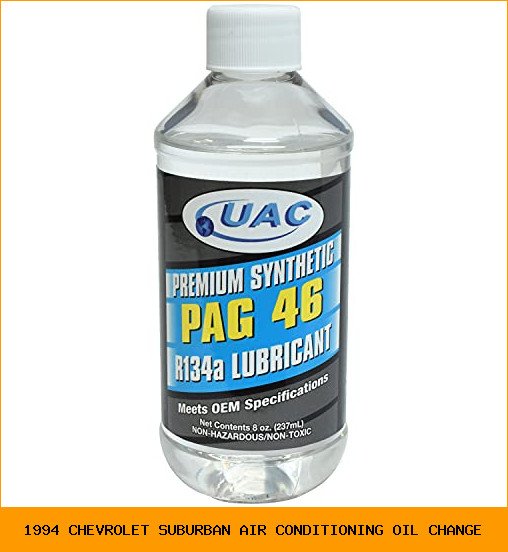
In this guide
You hop into your 1994 Chevrolet Suburban on a July afternoon, crank the AC, and all you get is warm air — or worse, a groaning noise from the compressor that sounds like a dying animal. Most people chase the problem with refrigerant cans or replace the compressor without ever asking: what about the oil? The compressor oil in a 1994 Suburban AC system does more than lubricate. It carries heat away, seals the reed valves, and keeps the desiccant bag in the receiver-drier from turning into sludge. Ignore it, and you'll shorten the life of every sealed component.
By the time you finish this article, you'll know exactly what oil your Suburban needs, how much, when to change it, and the three stupid mistakes that send DIYers back to the parts counter. I've rebuilt enough of these R134a-converted or factory-R12 systems to have strong opinions — and a few scars from PAG oil spraying in my face. Let me save you both.

UAC
Universal Air Conditioner RO 0900B Refrigerant Oil
Fit type: Vehicle Specific;Fit Type: vehicle specific
Buy on AmazonOne product that makes this job easier: Universal Air Conditioner RO 0900B Refrigerant Oil. It's a PAG 46 oil that matches the factory viscosity for most 1994 Suburban compressors. You can grab a bottle on Amazon — check the current price. It works with R134a retrofits and factory R12 if you've already converted. I keep a quart in my toolbox.
Myth #1: You Never Need to Change the AC Oil
I hear this constantly. The argument: AC systems are sealed, oil doesn't get dirty, so just add refrigerant and go. That's wrong for two reasons. First, moisture and combustion byproducts sneak past the compressor shaft seal over time — not a lot, but enough to turn PAG oil acidic. Second, every time you open a line (replace a hose, condenser, or accumulator), you lose some oil. If you never add back the correct amount, the compressor starves and seizes.
General rule: change the oil every time you open the system for a major repair. If you've never opened it, but the Suburban has 150,000+ miles and the AC blows weak, it's worth evacuating, pulling the compressor, draining the old oil, and replacing it. The oil capacity on a 1994 Suburban with the factory Harrison HD6 compressor is 10.5 ounces (310 mL). That's not much — but missing by even 2 ounces can cause noise or insufficient cooling.
Another common scenario: you converted from R12 to R134a at some point and used a cheap 'universal' oil. That old mineral oil mixed with ester oil can gel up when exposed to PAG. If you don't know what's in there, assume it's wrong and start fresh.
Myth #2: Any PAG Oil Will Work
PAG oil comes in different viscosities — PAG 46, PAG 100, PAG 150. The 1994 Suburban compressor (usually a Delphi or Harrison axial-piston type) needs PAG 46. People grab PAG 100 because it's thicker and think 'more protection.' Wrong. That's like running 20W-50 engine oil in a motor designed for 5W-30. It won't circulate properly at low temperatures, and the compressor will slug oil on startup.
Always check your service manual. For the 1994 model year, GM spec'd PAG 46 for R134a systems. If your Suburban still runs R12, use mineral oil (which is a different beast). But 90% of these trucks have been converted by now. If you're unsure, drain the compressor and look at the oil color. Brown or black means contamination. Milky means moisture ingress. Clear with a slight amber tint is healthy. Replace with fresh PAG 46.
And please don't use 'stop-leak' products that claim to condition oil. Those sealants clog the orifice tube and kill the compressor faster than running dry. Trust me, I've cut open enough clogged tubes to prove it.
Step-by-Step: How to Change the AC Oil Properly
Tools and Materials
- Manifold gauge set (R134a for converted systems, R12 for original)
- Vacuum pump (at least 4 CFM)
- Compressor oil — PAG 46, e.g., Universal Air Conditioner RO 0900B
- New accumulator (receiver-drier) — replace it any time the system is open
- O-ring kit for 1994 Chevy Suburban AC fittings
- Torque wrench (inch-pounds for small bolts)
- Safety glasses and nitrile gloves
Safety Precautions
Wear safety glasses. PAG oil is water-absorbing and burns your eyes if splashed. Always recover refrigerant before opening any line — venting R12 or R134a to atmosphere is illegal and bad for the ozone. Use a certified recovery machine or have a shop do that step.
Procedure
- Evacuate the system. Connect gauges, run recovery machine until pressure hits zero. Then pull vacuum for 30 minutes minimum to boil off moisture. If vacuum doesn't hold below 500 microns for 10 minutes, you have a leak — fix it before adding oil.
- Remove the compressor. Disconnect the negative battery cable. Unbolt the compressor from the bracket (19 mm socket usually). Tilt it to drain the old oil into a measuring cup. Note the amount — if it's way less than 10.5 oz, the oil is trapped in the system. That's fine; you'll add the total capacity minus what drained.
- Replace the accumulator. The accumulator (big black can near the firewall on passenger side) holds oil and desiccant. Once opened to atmosphere, it must be replaced. Unscrew the line fittings, pull it out, and install a new one with fresh o-rings lightly coated with PAG oil.
- Add the correct amount of fresh oil. Pour 10.5 ounces of PAG 46 into the compressor suction port (the larger opening) while slowly rotating the clutch hub by hand. This primes the reed valves. Reinstall the compressor and tighten bolts to 30 ft-lb.
- Evacuate again. Hook everything up, pull vacuum for 45 minutes. Then charge with refrigerant per the underhood label (typically 2.5–3 lbs of R134a after conversion). Start the engine, run AC on max, check pressures — low side 25–35 psi, high side 200–250 psi on an 80°F day.
One tip: after adding oil but before vacuum, spin the compressor clutch by hand five full rotations. This distributes oil across the pistons and prevents a dry startup when you first fire the engine.
Troubleshooting Common AC Problems That Aren't Oil-Related
Oil change won't fix everything. Here are three issues people blame on oil but are actually something else:
- No cold air but compressor cycles. Likely low refrigerant charge or a clogged orifice tube. Measure pressures. If low-side is below 20 psi, add refrigerant first. Oil won't help.
- Loud knocking from compressor. Could be low oil level, but more often it's a failing clutch bearing or loose mounting bolts. Check oil level first. If it's correct but noise persists, replace the compressor — the internal breakaway plate may be slipping.
- AC blows cold then warm. Typical symptom of a failing expansion valve or moisture freezing the orifice. Replace the accumulator, pull a deep vacuum, and recharge with correct oil amount. If it still happens, the compressor may have internal damage from old contaminated oil.
A quick way to check oil condition without draining: pull the low-side service cap. Use a clean paper towel to dab the Schrader valve. If the oil that seeps out is dark brown or smells burnt, change it ASAP.
Comparing Oil Types: What You Need for a 1994 Suburban
Use this table to match your system type to the correct oil:
| System Type | Oil Type | Viscosity | Capacity (oz) | Notes |
|---|---|---|---|---|
| Factory R12 (original) | Mineral oil (e.g., SUNOCO 100) | 500 SUS at 100°F | 10.5 | Hard to find; retrofit to R134a recommended |
| Retrofitted to R134a with PAG | PAG 46 | ISO 46 | 10.5 | Preferred for all 1994 compressors; Universal Air Conditioner RO 0900B fits |
| Retrofitted with POE | POE (polyolester) | ISO 46 or 68 | 10.5 | Works but not recommended for piston compressors; can foam |
If you're doing a fresh R134a conversion, flush the entire system with a compatible solvent first. Mixing mineral oil residue with PAG creates sludge. Not worth the risk.
5 Real Questions People Ask About 1994 Suburban AC Oil Changes
Can I just add oil without draining the old stuff?
Only if you know exactly how much is in there. Overfilling is worse than underfilling — excess oil coats the condenser and reduces heat transfer. Drain the compressor, measure what comes out, then add enough to reach 10.5 oz total. If you can't drain, don't guess.
Do I need to change oil if I'm just topping off refrigerant?
No. Refrigerant carries a small amount of oil with it, but unless you've lost more than half the charge, the oil stays in the system. Only add oil if you replaced a component or the compressor is making noise.
What happens if I use the wrong viscosity PAG?
Thicker oil (PAG 100) won't flow through the orifice tube at low RPM. At startup, the compressor draws oil from the accumulator — if it's too thick, the reed valves get insufficient lubrication and wear out inside 500 miles. You'll hear chatter within a week.
My 1994 Suburban has rear AC. Does that change oil capacity?
Yes, by about 2 ounces. A factory rear evaporator and lines hold extra oil. Total system capacity with rear AC is 12.5 ounces. If you've drained only the front compressor, add that much. Best practice: consult the underhood sticker or a service manual for your exact VIN.
Can I reuse oil that I drain from the compressor?
No. Once drained, it's contaminated with metal wear particles, moisture, and degraded additives. Throw it away properly (recycle at an auto parts store). Always use fresh oil from a sealed container.
What to Walk Away With
Here's the short version — bookmarkable notes:
- Use PAG 46 oil — nothing else — for any R134a system in a 1994 Chevy Suburban.
- Oil capacity is 10.5 ounces (front AC only) or 12.5 ounces if you have rear AC.
- Change oil every time you open the system for a repair. No exceptions.
- Always replace the accumulator when the system is opened. It costs $30 and saves your compressor.
- Drain old oil into a measuring cup to verify what came out — don't trust assumptions.
- If the oil looks black or milky, flush the whole system before adding fresh oil.
- Universal Air Conditioner RO 0900B is a solid, no-fuss choice for PAG 46 at a fair price — check the current deal on Amazon.
I still remember the first time I skipped the oil measurement on a friend's 1994 Suburban. Two months later his compressor grenaded. Don't learn that lesson the hard way.

Eng. Kamrul Islam
Founder and product researcher
Engineer with more than 10 years of experience researching and selling products on Amazon, including his own brand on Amazon Australia. He compares specs, standards, sellers and owner feedback.
All guides by Eng. Kamrul IslamMore in motor & engine oils
All 185 guidesThe 7 Best Engine Oils Like Tar of 2026
Discovering the best engine oil that's thick and protective like tar can be crucial for maintaining your vehicle's…
What Motor Oils Are Group 5
Motor oils are essential for the smooth operation and longevity of your vehicle’s engine. While most car owners…
How Much Motor Oil
Choosing the right amount of motor oil for your vehicle is a crucial aspect of car maintenance that…